Fabricación de celdas solares basadas en Sb2S3: Un análisis teórico a través de SCAPS-1D y validación experimental
Resumen
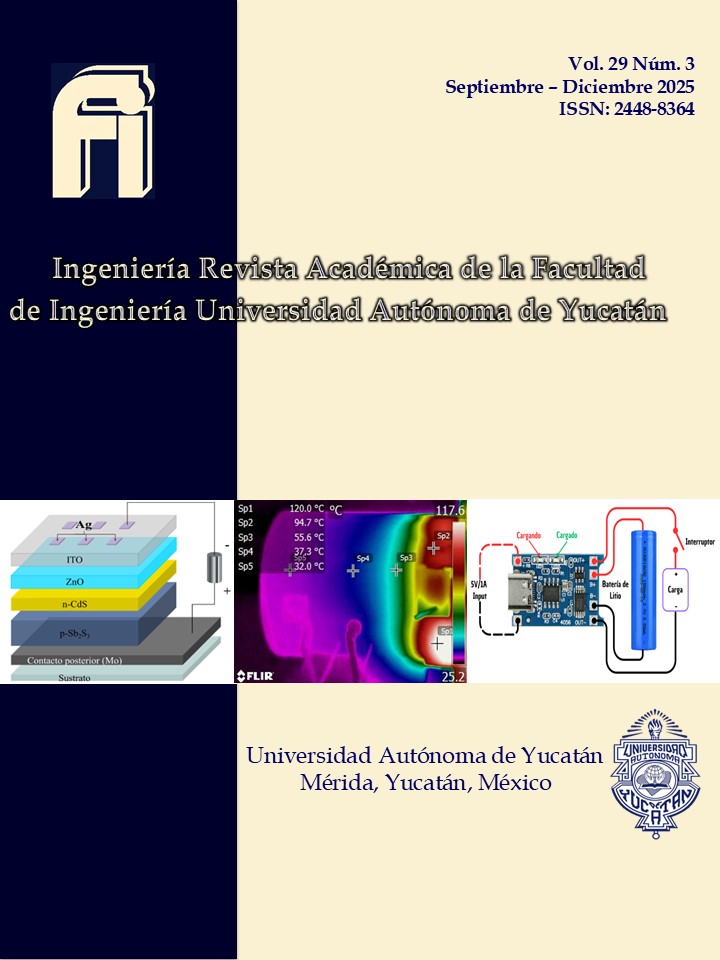
Los calcogenuros de antimonio, particularmente el sulfuro de antimonio (Sb2S3), son materiales prometedores gracias a sus excelentes propiedades optoelectrónicas, así como su baja toxicidad, bajo costo y gran accesibilidad. En este trabajo se ha modelado con el software SCAPS-1D una celda solar de Mo/Sb2S3/CdS/ZnO/ITO/Ag y posteriormente, se ha fabricado la celda solar con la misma estructura. A través de la optimización del espesor de las capas absorbente y ventana se consigue mediante SCAPS-1D una alta eficiencia del 19.9% con valores de resistencias en serie y shunt de 9.9 y 3103 Ω, respectivamente. De igual forma, se observó que un metal con una función de trabajo de ~4eV funciona mejor como contacto frontal en la celda estudiada, sin embargo, teóricamente no se obtuvieron mejores resultados en las propiedades de la celda con la adición de Ag como contacto frontal. La optimización al modelo teórico permitió obtener un rendimiento fotovoltaico de 6.5 % de eficiencia. Todo este trabajo se complementó con la fabricación experimental de una celda solar basada en Sb2S3 en la que se consiguió un 0.1 % de eficiencia. Este resultado es prometedor para profundizar en la optimización experimental de las celdas solares basadas en Sb2S3.
Citas
Abraham, P., Shaji, S., Avellaneda, D. A., Aguilar-Martínez, J. A., & Krishnan, B. (2023). Sb2S3 thin films: From first principles to in situ crystalline thin film growth by ultrasonic spray pyrolysis. Materials Science in Semiconductor Processing, 156, 107269. https://doi.org/10.1016/j.mssp.2022.107269
Ahamed, Sk. T., Basak, A., & Mondal, A. (2023). Device modeling and investigation of Sb-based low-cost heterojunction solar cells using SCAPS-1D. Results in Optics, 10, 100364. https://doi.org/10.1016/j.rio.2023.100364
Barthwal, S., Gupta, R., Kumar, A., Ramesh, K., Pathak, S., & Karak, S. (2023). Band offset engineering in antimony sulfide (Sb2S3) solar cells, using SCAPS simulation: A route toward PCE > 10%. Optik, 282, 170868. https://doi.org/10.1016/j.ijleo.2023.170868
Basak, A., & Singh, U. P. (2021). Numerical modelling and analysis of earth abundant Sb2S3 and Sb2Se3 based solar cells using SCAPS-1D. Solar Energy Materials and Solar Cells, 230, 111184. https://doi.org/10.1016/j.solmat.2021.111184
Basore, P. A. (1990). Numerical modeling of textured silicon solar cells using PC-1D. IEEE Transactions on Electron Devices, 37(2), 337–343. https://doi.org/10.1109/16.46362
Burgelman, M., Nollet, P., & Degrave, S. (2000). Modelling polycrystalline semiconductor solar cells. Thin Solid Films, 361–362, 527–532. https://doi.org/10.1016/S0040-6090(99)00825-1
Choi, Y. C., Lee, D. U., Noh, J. H., Kim, E. K., & Seok, S. I. (2014). Highly Improved Sb 2 S 3 Sensitized‐Inorganic–Organic Heterojunction Solar Cells and Quantification of Traps by Deep‐Level Transient Spectroscopy. Advanced Functional Materials, 24(23), 3587–3592. https://doi.org/10.1002/adfm.201304238
Farhana, M. A., Manjceevan, A., & Bandara, J. (2023). Recent advances and new research trends in Sb2S3 thin film based solar cells. Journal of Science: Advanced Materials and Devices, 8(1), 100533. https://doi.org/10.1016/j.jsamd.2023.100533
Islam, M. T., & Thakur, A. K. (2020). Two stage modelling of solar photovoltaic cells based on Sb2S3 absorber with three distinct buffer combinations. Solar Energy, 202, 304–315. https://doi.org/10.1016/j.solener.2020.03.058
Islam, M. T., & Thakur, A. K. (2023). Effect of design modification on efficiency enhancement in Sb2S3 absorber based solar cell. Current Applied Physics, 49, 25–34. https://doi.org/10.1016/j.cap.2023.02.007
Kosarian, A., Shakiba, M., & Farshidi, E. (2018). Role of sputtering power on the microstructural and electro‐optical properties of ITO thin films deposited using DC sputtering technique. IEEJ Transactions on Electrical and Electronic Engineering, 13(1), 27–31. https://doi.org/10.1002/tee.22494
Kumari, R., Mamta, Kumar, R., & Singh, V. N. (2023). Simulation Study of an Antimony Selenide Solar Cell with Graphene Oxide as Hole Transport Material. ACS Applied Electronic Materials, 5(7), 3949–3956. https://doi.org/10.1021/acsaelm.3c00631
Lan, C., Luo, J., Lan, H., Fan, B., Peng, H., Zhao, J., Sun, H., Zheng, Z., Liang, G., & Fan, P. (2018). Enhanced Charge Extraction of Li-Doped TiO2 for Efficient Thermal-Evaporated Sb2S3 Thin Film Solar Cells. Materials, 11(3), 355. https://doi.org/10.3390/ma11030355
Li, Z.-Q., Ni, M., & Feng, X.-D. (2020). Simulation of the Sb 2 Se 3 solar cell with a hole transport layer. Materials Research Express, 7(1), 016416. https://doi.org/10.1088/2053-1591/ab5fa7
Liu, L., Zhang, S.-L., Wu, J.-Y., Wang, W.-H., Liu, W., Wu, L., & Zhang, Y. (2020). Current improvement in substrate structured Sb 2 S 3 solar cells with MoSe 2 interlayer*. Chinese Physics B, 29(5), 058801. https://doi.org/10.1088/1674-1056/ab8220
Luo, J., Xiong, W., Liang, G., Liu, Y., Yang, H., Zheng, Z., Zhang, X., Fan, P., & Chen, S. (2020). Fabrication of Sb2S3 thin films by magnetron sputtering and post-sulfurization/selenization for substrate structured solar cells. Journal of Alloys and Compounds, 826, 154235. https://doi.org/10.1016/j.jallcom.2020.154235
Mamta, Maurya, K. K., & Singh, V. N. (2021). Sb2Se3 versus Sb2S3 solar cell: A numerical simulation. Solar Energy, 228, 540–549. https://doi.org/10.1016/j.solener.2021.09.080
Martin, I. T., Crowley, K., & Hepp, A. F. (2023). Thin-film materials for space power applications. En Photovoltaics for Space (pp. 215–263). Elsevier. https://doi.org/10.1016/B978-0-12-823300-9.00015-7
Nagaraja, M., Raghu, P., Mahesh, H. M., & Pattar, J. (2021). Structural, optical and Urbach energy properties of ITO/CdS and ITO/ZnO/CdS bi-layer thin films. Journal of Materials Science: Materials in Electronics, 32(7), 8976–8982. https://doi.org/10.1007/s10854-021-05568-4
Nykyruy, L. I., Yavorskyi, R. S., Zapukhlyak, Z. R., Wisz, G., & Potera, P. (2019). Evaluation of CdS/CdTe thin film solar cells: SCAPS thickness simulation and analysis of optical properties. Optical Materials, 92, 319–329. https://doi.org/10.1016/j.optmat.2019.04.029
Putra, N. M. D., Sugianto, Marwoto, P., Murtafiatin, R., & Permadis, D. (2021). The SCAPS-1D modeling of ZnO/CdS/CdTe thin film: Analysis of thickness and stoichiometric fraction of absorber layer on solar cell performance. Journal of Physics: Conference Series, 1918(2), 022029. https://doi.org/10.1088/1742-6596/1918/2/022029
Rios-Flores, A., Arés, O., Camacho, J. M., Rejon, V., & Peña, J. L. (2012). Procedure to obtain higher than 14% efficient thin film CdS/CdTe solar cells activated with HCF2Cl gas. Solar Energy, 86(2), 780–785. https://doi.org/10.1016/j.solener.2011.12.002
Scarpulla, M. A., McCandless, B., Phillips, A. B., Yan, Y., Heben, M. J., Wolden, C., Xiong, G., Metzger, W. K., Mao, D., Krasikov, D., Sankin, I., Grover, S., Munshi, A., Sampath, W., Sites, J. R., Bothwell, A., Albin, D., Reese, M. O., Romeo, A., … Hayes, S. M. (2023). CdTe-based thin film photovoltaics: Recent advances, current challenges and future prospects. Solar Energy Materials and Solar Cells, 255, 112289. https://doi.org/10.1016/j.solmat.2023.112289
Shah, U. A., Chen, S., Khalaf, G. M. G., Jin, Z., & Song, H. (2021). Wide Bandgap Sb 2 S 3 Solar Cells. Advanced Functional Materials, 31(27), 2100265. https://doi.org/10.1002/adfm.202100265
Sharma, I., Pawar, P. S., Yadav, R. K., Kim, Y. T., Bisht, N., Patil, P. R., & Heo, J. (2024). Vapor-transport-deposited Sb2S3 thin-film solar cells: Tailoring photovoltaic properties through deposition temperature. Journal of Power Sources Advances, 26, 100143. https://doi.org/10.1016/j.powera.2024.100143
Soonmin, H., Hardani, Nandi, P., Mwankemwa, B. S., Malevu, T. D., & Malik, M. I. (2023). Overview on Different Types of Solar Cells: An Update. Applied Sciences, 13(4), 2051. https://doi.org/10.3390/app13042051
Wang, Q., Chen, Z., Wang, J., Xu, Y., Wei, Y., Wei, Y., Qiu, L., Lu, H., Ding, Y., & Zhu, J. (2019). Sb 2 S 3 solar cells: Functional layer preparation and device performance. Inorganic Chemistry Frontiers, 6(12), 3381–3397. https://doi.org/10.1039/C9QI00800D
Wibowo, A., Marsudi, M. A., Amal, M. I., Ananda, M. B., Stephanie, R., Ardy, H., & Diguna, L. J. (2020). ZnO nanostructured materials for emerging solar cell applications. RSC Advances, 10(70), 42838–42859. https://doi.org/10.1039/D0RA07689A
Xiao, Y., Wang, H., & Kuang, H. (2020). Numerical simulation and performance optimization of Sb2S3 solar cell with a hole transport layer. Optical Materials, 108, 110414. https://doi.org/10.1016/j.optmat.2020.110414
Zapata-Torres, M., Fernández-Torres, J. L., Hernández-Rodríguez, E., Mis-Fernández, R., Rejon, V., Peña, J. L., Valaguez-Velazquez, E., & Márquez Herrera, A. (2015). Study on the ITO/ZnO interface and its effect on CdS/CdTe solar cell performance. 28(2), 61–65.

Esta obra está bajo licencia internacional Creative Commons Reconocimiento-NoComercial 4.0.
Avisos de derechos de autor propuestos por Creative Commons
1. Política propuesta para revistas que ofrecen acceso abierto
Aquellos autores/as que tengan publicaciones con esta revista, aceptan los términos siguientes:
- Los autores/as conservarán sus derechos de autor y garantizarán a la revista el derecho de primera publicación de su obra, el cuál estará simultáneamente sujeto a la Licencia de reconocimiento de Creative Commons que permite a terceros compartir la obra siempre que se indique su autor y su primera publicación esta revista.
- Los autores/as podrán adoptar otros acuerdos de licencia no exclusiva de distribución de la versión de la obra publicada (p. ej.: depositarla en un archivo telemático institucional o publicarla en un volumen monográfico) siempre que se indique la publicación inicial en esta revista.
- Se permite y recomienda a los autores/as difundir su obra a través de Internet (p. ej.: en archivos telemáticos institucionales o en su página web) antes y durante el proceso de envío, lo cual puede producir intercambios interesantes y aumentar las citas de la obra publicada. (Véase El efecto del acceso abierto).